
Today I woke up thinking about brain surgery. It’s not a normal thing to contemplate when you first wake up on a grey, February morning (unless you’re a neurosurgeon), but today I did. I actually woke up to the sound of grinding, revving engines and sewer work in the street outside my bedroom window. It was close to 6am, definitely before 7am, and the sound had worked its way into my dream. Something about waiting and being in a waiting room. We’re really familiar with waiting rooms. We spend a lot of time in them. The sound had worked its way into the dream as an annoyance within the dream itself. Something was supposed to be happening in that waiting room and there was this irritating whirring in the background. Even in the dream I was like “What the hell is that? Shut that thing off. We’ve got things to stress about here.” When I opened my eyes, pissed off in the dark, the feeling of the waiting room lingered…the pale yellow walls, the harsh fluorescent lights, the smell of worn chairs with a decade of old spilled coffee worked into their fibres, mixed with the smell of industrial strength floor cleaner. I thought about calculating the number of hours we’ve spent in this particular waiting room, which led me to think about the longest “session” we’ve had in this particular waiting room. I thought about my daughter’s brain surgery. The first one. It was special.
Not surprisingly, brain surgery takes a long time. Recovery takes a long time. Everything takes a long time. And that means waiting. Lots of waiting. As a parent, it can be difficult (to say the least) to figure out what to do while you are waiting. It’s not like you’re killing time at swimming lessons. You clearly have a lot on your mind, and need distraction, but it’s also difficult to focus on anything. You’re obviously in a pretty delicate state, so what you focus on is also important. Because we had a few days notice that our wait time was approaching, friends and family gifted us with books and magazines and crossword puzzles and snacks. We had our daughter’s bag packed for the hospital and we had our own bag of tricks for the wait. It was, after all, a full workday (predicted 8-10 hours) of fear and rage and helplessness. I wish that was hyperbole.
So, what do you do while a team of 10(ish) very qualified professionals open up and tinker with your kids’ control system?
You sit in a waiting room with other parents and family members of kids who are also under the knife. Everyone is anxious, but not everyone shows it.
Some of the people beside you are tense and tearful because their very little ones are in for a five-minute surgery to put in ear tubes. This fear is valid. Anesthetic is always kind of scary and surgery is surgery, despite the calm and breezy manner of the medical professionals involved in same day procedures. We’d been these parents twice already. In fact, the day our daughter’s more serious symptoms started to manifest, her father had been sat in this same waiting room for her older brother’s second set of ear tubes. That day, I’d stayed home with our daughter, because she’d vomited in the early hours of the morning and couldn’t go to daycare.
Some parents are there for their teenage child’s appendix removal. Or maybe their budding jock is getting a torn ligament repaired after a sports injury.
Some people, like us, are there because their kid could die and this surgery is the thing that will hopefully save them. Everyone is in the same waiting room. We didn’t realize this when we were in for our son’s ear tubes. You assume that the “big stuff” gets its own waiting room. Incorrect.
It’s another one of life’s lessons in empathy. Look around the room, any room, and someone there is likely to be going through a field of shit.
Whatever their reason for being there, most people are on their phones. My husband and I, for example, were trying to read on ours.
I was in a book club (that would prove to be an unbelievably supportive and important presence in my life throughout this period, and in all the days since). We were reading, for the first time in a cohort of contemporary and historical fiction fans, a dystopian sci-fi novel. This is generally my escapist bread and butter. It was gloomy and slow, and I didn’t really like it, but I’d suggested it to the group and it was something to focus on that had nothing to do with our situation. Reading kept us from crying. Word puzzles and Sudoko didn’t work so well. They didn’t divert enough thought power to really phase out of our situation.
When I wasn’t reading, I was drawing. Nothing concrete, nothing focused. I was doodling lines. Lots and lots of long, fluid lines, in different colours that flowed and overlapped and merged together. I drew until my hand cramped, took a break to read a bit or stretch my legs, then I’d draw some more. I kept the same drawing in progress over the next week or so as well, as time allowed. It’s not a good or interesting drawing. I’m self-taught so I’ve got no technique whatsoever and my skill set is limited, but drawing is the closest I get to a meditative state. I know I passed a few hours that day marking the page, thinking that each line drawn was a connection being made, being saved in my daughter’s brain. I’m no neurologist (I use this line more frequently than you’d think), but I know that the brain is capable of rebuilding and rerouting, even when it has been devastated. As the pen tip scraped across the paper, as I retraced those lines to darken or thicken them or to change their direction, I thought of the pathways sending signals back and forth in her little brain and counted each line drawn as a new highway constructed. It makes no logical sense whatsoever, but it made me feel like I was part of that team, trying to save as much as they could of who she was and what she would be capable of after the surgery. It made me think less and gave me something to do. The other part of my brain, that needed more diversion, listened to and watched the TV screens mounted in the waiting room.
There’s something consistent about TV screens in hospital waiting rooms that you don’t notice until you spend a lot of time in them. There is always at least one screen playing the Home and Garden channel. It is an ever-present and innocuous feature of these kinds of waiting areas.
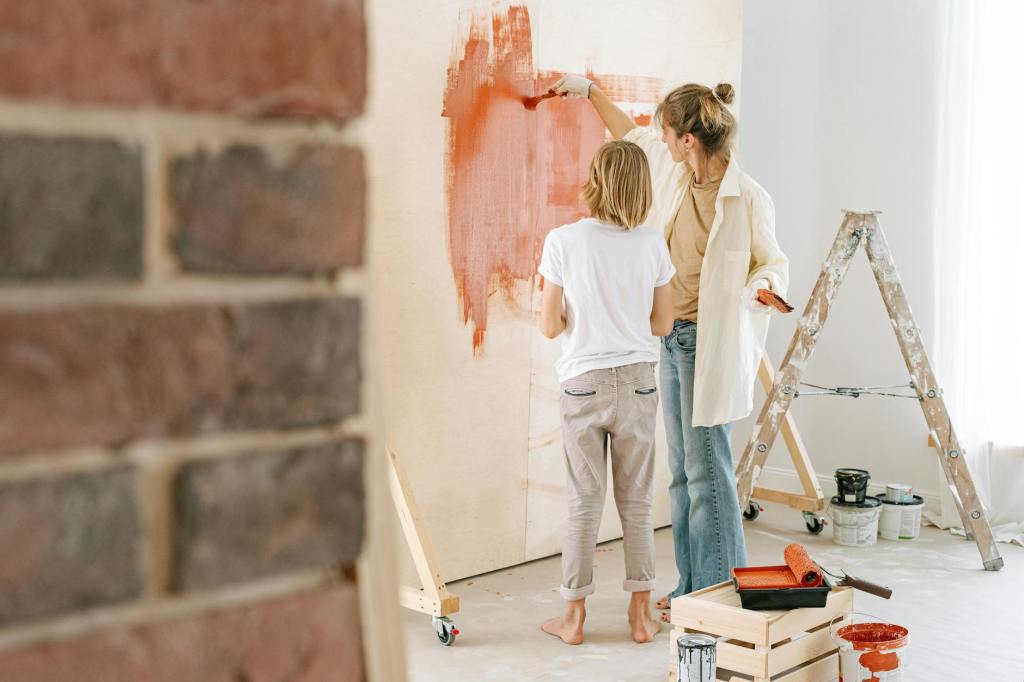
Don’t get me wrong, I’ve always loved HGTV. It started in the early 2000s with shows where neighbours redecorated each other’s homes. In the years that followed, it became a source of inspiration and heated debate, made more interesting because my partner and friends had our own homes with updates and repairs and renovations to be dealt with. Watching the shows fueled my homeowner dreams and desires and admittedly, from time-to-time, indulged the less savoury, more judgey and envious aspects of my personality. On business trips, I’d arrive at my hotel after a long conference day, kick off my shoes and binge watch house flipping renovation shows, tsking and shaking my head at obnoxious colours and sighing over luxury tubs I felt I deserved more than the home owners I saw on the screen.
HGTV is still a land I’m happy to visit, but it means something different now. HGTV, like certain hues of green, or blue, or peach (the studied, soothing colours of medical institutions) lets me know that I’ll be settling into a stiff vinyl chair with a paper cup coffee for at least an hour. It tells me I’ve got some time to kill while my kid sleeps on industrial cotton-poly sheets, before Peppa Pig or the Wiggles go back on. It says we’re back in hospital and that we’re going to be there for a while.
I’ve given more thought than a reasonable individual should, to why HGTV is so popular among the demographics that frequent medical institutions. Here’s what I’ve come up with.
- It’s not Treehouse, or Nickelodeon, or any other kid-focused cable channel that runs the same 8-10 syndicated shows on repeat, day or night. In a children’s hospital, you WILL be watching day and night and your kid WILL want the t.v. on all the time and with all the other shit they’re going through, it’s not a battle you’re willing to fight. As soon as the opportunity presents itself NOT to watch another episode of Paw Patrol, you need something you can rely on. Hospital television set-ups do not lend themselves to channel surfing, and in your depleted state, almost any decision, even what to watch, can be hard to make. In short, it’s not a kid’s show, and it’s a decision made for you that you don’t hate.
- It’s nice to think of homes. Not necessarily YOUR home, because you may be a long way from it (geographically or metaphorically), but home, as a concept, is comforting and aspirational. It’s nice to think, “Maybe I’ll repaint the trim when we get home. You know, freshen things up after all this shit.” It’s nice to think of home as a place you will get back to and that you have some control over. Homesickness is a thing during long stays in an institution. Home is, at once, an idea, a destination, and a solution.
- Home and garden shows are relatively “safe.” They are good shows for conversation or diversion, without lighting any emotional or political fires. While presenters and participants are occasionally obnoxious, home shows don’t generally present anything controversial. The visuals distract from the hosts’ inane banter and the topics can usually be judged subjectively from a point of “personal taste” over political leaning. House hunting and sales shows aren’t as rowdy or riveting as sporting events, though sports highlights are probably next in line for acceptable hospital programming. The News is the last thing you want to watch when your life is already scary and depressing and overwhelming, and sitcoms piss you off because, who gives an actual fuck if whichever “Ross and Rachel”-type couple ever get together…your child is lying there full of drugs and tubes and needles.
In HGTV land, that walnut-stained chevron pattern looks stunning in that kitchen. That cream sofa looks great, but it’ll last a few months, tops, with a great Dane in the house. Holy crap, that ridiculous square footage is cheap in Austin, Texas. Anywhere parents assemble in a pediatric hospital will have a home improvement, or flipping, or house-hunting show on. Strangers will strike up conversation about DIY home improvement, or sit quietly on their phones, eating greasy hospital muffins while it plays in the background. Everything else in your head is heavy and hard, but on the Home and Garden channel, none of it really matters and you know exactly what you’re going to get. Comfort in a paint can. Diversion with shrubbery. As good as it gets, given the situation.


Leave a Reply