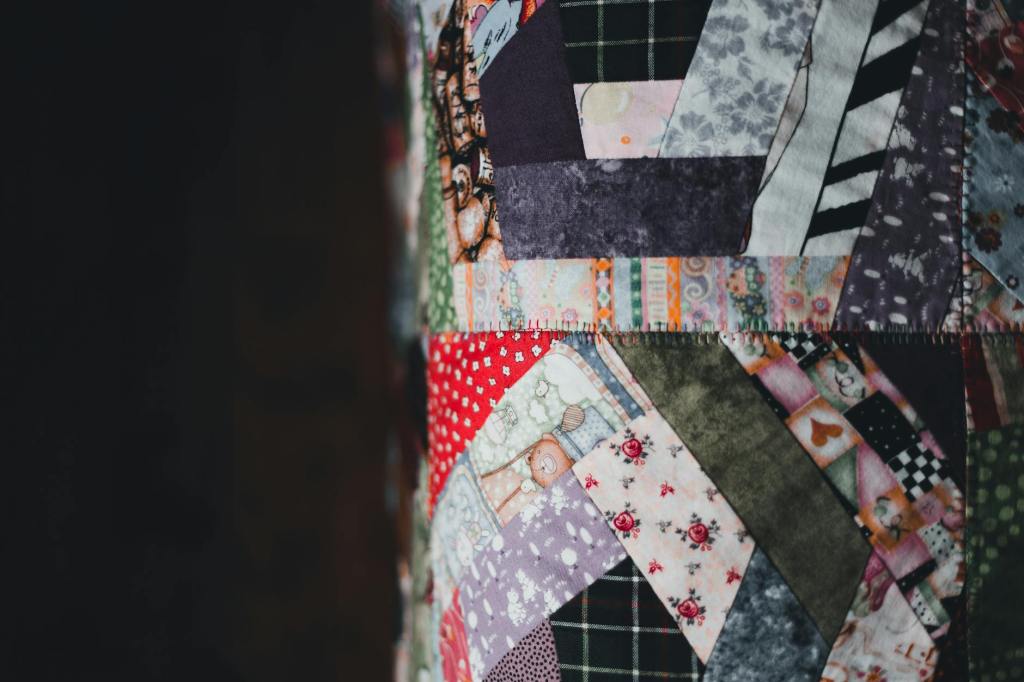
A quilt is a beautiful thing. On so very many levels.
To start, quilts are brain candy. Straight up colours and shapes and repeating patterns injected right through your eye holes to the wrinkles in your brain.
They FEEL amazing. There’s something soothing about a blanket with a hundred little lines and pathways to trace with your fingers in the dark.
Quilts are this brilliant compilation of art and math and human dexterity. As a creative and a collector of hobbies, I’ve always wanted to learn how to quilt, but my brain measures and tessellates so poorly. I don’t think I’m built for it. I don’t think you can swear and improvise your way through a 1000 piece project.
Quilts are also this meaningful and tender thing. They take a creative vision, intention, love, and patience and in the end, it literally wraps around the recipient of the final product.
Recently I watched a short documentary on Netflix called, “The Quilters”. It’s about a group of men in a Missouri maximum-security prison who volunteer their time to make quilts for children in foster care. They are people who have made mistakes and lived hard lives, finding purpose through their work to make something for someone they don’t know and will never meet. The film follows the quilters, but watching it reminded me of our experience, as recipients, of something similar.
When our child was little, really little, and sick, really sick, she was gifted a small handmade quilt from a local organization. This group of volunteers makes and shares pillow cases and hospital bed sized quilts for kids on long stays. The goal: to make everything a little cozier and friendlier. And it makes a difference. It really does. Seven years later my kid still keeps that quilt on her bed and we still pack it for long stays. The soft flannel on the back side is a little faded but the colourful animals and flower patterns on the front are still bright and sweet. Her pillow cases (collected over several long stays in hospital) are still in weekly circulation.
The magic of a quilt is hundreds (or thousands) of little pieces coming together. Thousands of little acts make those little pieces possible. The fabric is picked and matched and pondered. The pattern is conceived and drawn. Tiny strips and squares and diamonds are measured and cut and placed and stitched and ironed and sewn together into bigger and bigger elements.
And that’s how real support works when things are hard. When someone is lost or sick or hurt. It’s a thousand small acts of care and consideration that brings them back or holds them up. A thousand small gestures of sympathy and understanding. A thousand tiny problems that get solved by people who love and empathize both with their loved ones, but also with total strangers.
A quilt is a magical thing because it is literally created to cover a human body with these thousand acts of effort and good intentions.
So here’s to the strangers who create intricate works of art and love, one small intentional act at a time, to keep other strangers warm.
About a year and a half ago my body told me to stop. Stop working. Stop exercising. Stop socializing. Just stop.
What should have been a relatively minor middle-aged grumble and a few weeks of old lady noises turned into months of debilitation, a touch of permanent nerve damage, and a bonus year of personal lockdown.
As the primary caregiver in our house, this caused a breakdown in the system. I worked part time to pay the bills but being a caregiver was my job. The system that ran and fed and kept the gears turning in our house, fell apart for a while and we needed some help to keep it together.
It’s not that my partner didn’t do any of these things, but neither of us did them alone. We’ve always done a good job of dividing and conquering tasks, especially considering the additional time and mental load of our youngest child’s medical complications. But, if there’s anything we’ve learned in the last seven years, it’s that the world can flip upside down at any given moment.
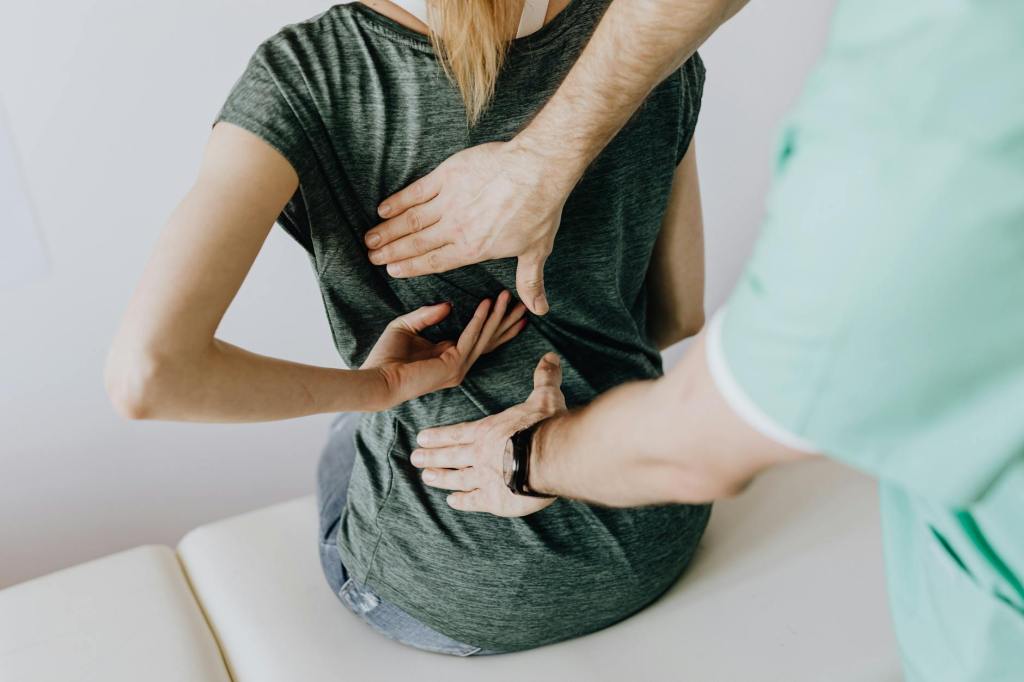
One morning, after a couple months of standard caregiver’s back pain, I couldn’t stand up. It had been a perfect storm of gradual degeneration, a “heroic” catch on some stairs, and a slip on the ice. A couple of ER visits later, I became the official owner of some thoroughly ruptured discs and a severely compressed nerve. Woot. Woot. Caregiver down.
I’m incredibly grateful that I have the kind of partner that can and did take on the full-time job of parenting as well as all the layers and appointments that come with the conditions our youngest child deals with every day. I could manage some of this from a horizontal position, but there wasn’t a whole lot I could actually do. No cleaning, no driving, no appointments, no ER visits or hospital stays. For a good six months, he looked after me in addition to the kids and the dog. For the better part of a year, he had to do everything outside the house as well. He did this in addition to his actual full-time job. We don’t really get vacations in this family, but the man really deserves a vacation.
My kids also stepped up to do what they could, bringing me food, keeping me company, and generally demonstrating an understanding way beyond their years, that sometimes parents get sick or hurt too. In this family, we have a decent amount of training in accommodating medical crises. When I went down our backup generators kicked into high gear.
We have grandparents that fed us as they swooped in to ferry me to appointments and kids to extracurriculars. We have brilliant friends that stepped in for carpools and took tea with me in the bedroom a la John and Yoko.
It was fucking hard and I’m not all better, but I am still progressing, and that’s with a tidal wave of gratitude pushing me forward. One thing that happens when you’re stuck on your back, for months at a time in your own little room, is evaluation. I cried a lot about what I loved and might never do again. I thought a lot about what I might be able to do, with time and healing. I waffled a lot about what direction my life should take from here on out and I got very very bored.
I flip between hobbies the way dads in the 90s changed TV channels, so I dug up some old favourites that I could do flat on my back. I started crocheting but lying flat and holding the hook and yarn above my chest messed up my shoulder. It worked, but I have to space it out now. Bit by bit, I make little creatures out of scraps of yarn. To be honest, they’re piling up.
I watched all the things I’d been meaning to watch. I read as much as I could.
I started drawing again, which has been magic. I couldn’t sit and draw with pen and paper but I could prop up an iPad or doodle on my stomach like a kindergartner, so I finally got into digital art. (Only about a decade behind on that one.)
I had to stop writing and editing (to the extent I needed to professionally), but I could point, click, and drag. So, like any reasonable Type A personality confined to a bed, I digitized our pen and paper caregiver binder.
I am a wild party.
I learned to use some new tools (thank you internet) and reworked the system we’ve been using to communicate and manage the ins and outs of our daughter’s care. Making graphic organizers is not the coolest hobby in my collection, but it tickled the part of my brain that needed to feel like I was contributing.
I couldn’t be at the appointments, but I could document the shit out of everything else.
I honestly used to think I was kind of a chill person. I was wrong. The tools and templates are good, I think. They help us, so I’m sharing them as widely as I can. I hope they help someone else feel like they have a little control over a hard situation.
What surprised me, is that I felt real joy and purpose in putting them together. I’d love to do it more. I’d love to make custom versions that work for all the unique and challenging situations families like ours integrate into our daily lives. I don’t know how that’s going to play out, but maybe it will. Life is nothing if not surprising these days.
I have had the privilege of tangible support and all the benefits of an emotionally available and loving community around me.
I’m still on the chronic pain list. I’m still not working and still don’t feel like I’m holding up my end of the bargain as it pertains to co-parenting or caregiving. But I’m trying to pay some good stuff forward and I’m trying to get back on the rails.
I aim to start posting regularly because this also tickles an important part of my brain that I haven’t used in a long time. I’m back. (As long as my back behaves.)
NOTE: If you’d like to check out the art, tools, and templates that have kept me in one piece this year, click the links below.
It’s all under Layer Cake Digital Design because life has been a layer cake of hard crusty bits and soft fluffy growth over last 7 years. More on that another time. For now, just take a look. Let me know what you think. Let me know if you have any suggestions. I’m all ears (and old lady back) over here.
Printable tools, templates, and art for caregivers on ETSY at:
… Intangible (ah y’all), bet you didn’t think So I command you to, panoramic view (you) Look, I’ll make it all manageable
Gorillaz – Clint Eastwood
I’m not sure I’ve ever really wrapped my head around this lyric, but it’s currently stuck on a loop in my head.
I have a wee quirk that makes my brain play clips (e.g., song lyrics, short scenes from movies) when a particular word is mentioned or when a certain situation arises. I have to work hard not to react aloud when this little play button gets pressed in my head. It’s harmless, but it’s a thing.
For example, I can’t hear the phrase “Think it’ll work?” (Or some variant of it), without responding in my head “It would take a miracle.” in Billy Crystal’s voice from The Princess Bride. I’ve been supressing the urge to say it out loud since the late 80s.
Similarly, I can’t hear “one time…” without hearing Wyclef Jean from the Fugees in Killing Me Softly. I’ve only been supressing the urge to say that aloud since the late 90s.
In 2023, it’s Gorillaz and Clint Eastwood. I’ve known the song for years. It’s a jam. I sincerely love it. But this year a particular word started to tweak my sound bite syndrome.
It’s “manageable.”
Manageable is, for the most part, perceived to be a good thing. In our world, in our medical world specifically, it generally comes with news that is not necessarily what you want to hear, but with the hope that you’re going to be able to do something about it.
Non-malignant brain tumour = manageable. Surgery and chemo…prognosis is good.
Monocular vision = manageable. In time she’ll adapt and likely even be able to drive.
“Manageable” is also how some minor deficiencies and shortfalls may be described.
The ongoing chemo and dairy allergy combined mean that bone health needs to be watched and monitored. Your kid fractures a few things over a couple of years, and you manage that. Her bones aren’t bad, but they may need a boost in the long run. Add supplements and get exercise in where you can. Totally manageable.
The term can also apply to complicated, scarier things that you just get used to and learn to manage over time.
Hemiparesis from my daughter’s stroke has been a big one to figure out, but we have teams of occupational therapists, physical therapists, and orthotists who’ve been helping us with this for years. As the person with the condition grows, they also problem-solve and figure out their own solutions. This condition was actually starting to feel like we could handle it. Plenty of setbacks, a pretty steep learning curve, and a shit tonne of work for a wee little kid, but life still happened around it. “Manageable.”
But there comes a point when layers of “manageable” start to compound. The pandemic didn’t help for sure. New protocols and stressors. New additional challenges to learning and socializing. Again, “manageable”, but not insignificant for anyone.
Continual tumour growth (though slow and steady thanks to the chemo) definitely added a few new layers too. At the beginning of this year our daughter was back for another round of brain surgery. They removed another massive amount of the tumour, which was awesome, but there have been consequences with her endocrine system**, which has not been awesome. Several new conditions requiring several new treatments. All of it ongoing and evolving. Some of it is life threatening in a whole new and exciting way.
**NOTE: The endocrine system, if you don’t know, is a big deal. It kind of runs a lot of the show behind the scenes. All those hormones that regulate growth and development, hunger and thirst, urine output, stress responses, and sleep…the hormones we take for granted long before puberty even enters the picture, and we get slapped in the face with an awareness of how wild our body can be.**
Our daughter’s endocrine system took a hit with this surgery. Five years ago, it was a stroke, and we didn’t know if we’d get to bring the same kid home with us. This time, our daughter woke up her bubbly, chatty self, but it quickly became apparent that some of the systems running in the background were not online.
These new developments have been a lot to manage.
The trigger for this most recent surgery has itself become another few layers of things to manage. Our daughter has had vision in just one eye since she was three. Other than protecting the good eye with super stylish kid glasses (she has better taste than I do), vision was not something we really followed closely. She only had one eye, but it was a good one. Until of course, it wasn’t. Changes to her vision prompted her second major surgery. It took the pressure off her optic nerve, but she didn’t regain what was lost.
Now, in addition to managing food allergies, accessibility, and learning deficits from illness and absence, in addition to life saving precautions and treatments for an endocrine system that’s barely phoning it in, this 8-year-old is also managing significant vision loss. And for the most part, she just fucking does it. It’s absolutely wild how much she just rolls along and lives her day-to-day through all manner of madness.
But it’s another layer, on top of many other layers, that are being managed…and for all of us, our daughter the rockstar included, it’s starting to feel a lot less manageable.
We’re good at this. We’ve been doing this most of her life now. We have teams of supporters in and out of the hospital that dab our brows with a towel and push us back into the ring every time we take a hit. But you can only take so many hits before you can’t get back up.
As parents, we’re also “managing” all those basic parent things, like trying to make sure both children get to school, that our daughter gets the opportunity to make friends with real live kids, that she learns to read (despite an embarrassing number of absences and a total lack of educational assistants for students with exceptionalities), that she gets to be an actual kid before she has to learn to manage all these extra shitty things herself.
I’m an organized, resourceful person and my partner is a smart, driven, dedicated parent. We work well together, and we have more resources and flexibility than many. But no tracking table or “ToDo” list can effectively capture all this. There aren’t enough hours in the day to manage all the 5–15-minute tasks and therapies and treatments we’re trying to implement and no app that can synchronize the choreography and timing of it all.
Each of these things takes time and brain power and a little bit of soul. As a caregiver and a parent, some days I feel crushed by the weight of the (literal and figurative) binder we carry to hold all this information. I feel guilty that I’m not doing her exercises enough, or getting her to drink enough, or playing with her enough because I’m always trying to get something DONE. It’s the time as parent and kid that gets cut for the time as caregiver and patient.
This is why I bristle at the word “manageable.” It’s not a bad word. It’s a good word. It carries hope and a plan of action. It also carries responsibility and weight that cannot be shifted to someone else. As much as we would like to lighten our load, focus on the positive, and affect some fucking self care, families like ours, with kids like ours, must accept that we cannot step out of the ring. The hits will keep coming and we will have to find a way to get up. (Cue Captain America sound bite: “I can do this all day.” I don’t feel it, but I hear it.)
So, I have a few requests.
To those who engage with us professionally and personally:
Please remember that we’re trying. We’re trying so hard. We are never not trying, even when it seems like we’re not. There are no breaks, no vacations, and no off switch. All of that requires planning and training and protocols as well. There is only prioritization, and we can only carry so much up front.
When we’re told that a condition, treatment, or situation is “manageable” please understand that a delicate balance is about to be disrupted and we’re trying not to explode.
15 minutes of therapy or tracking doesn’t sound like much but every day it has to work along with home reading, administration of meds and treatments, meal planning and prep, extra admin work and communication, insurance forms, emails advocating for or requesting services, extra calls with school staff, searching for shoes that fit over bulky orthotics, searching for or driving to activities that may or may not cater to your child’s particular needs, pharmacy runs, spontaneous specialist appointments and calls, midnight ER visits, and somewhere in there…we have two children that need us to pay attention to who they are actually becoming and what they need amongst the noise to be real live people.
Oh, and we also have to find a way to be employed. Maybe maintain a relationship or two. Maybe work on being human ourselves, instead of just the sum of our functions.
“Management” is the right word to use. Caregiving a job. It requires focus and expertise and an understanding of overarching goals and how it all fits together. It takes time to build the skills and the systems to integrate new tasks and procedures and we, as parents of medically complicated kids, don’t generally get a lot of time to do that. You are not likely the only one throwing a wrench in the system this week. We appreciate that it’s all important, but It’s. All. Important.
So please…
Be patient.
Be flexible. Your time is at a premium, but so is ours.
Tell us the good news (when you can).
Acknowledge the things we’re already doing and highlight what we’re doing right. This can change the course of our day completely.
Remember that our (brain) storage space is limited, and our processing power is taxed. Speak plainly and write terms, next steps, and drug names down. Give us something to Google and a reliable source to consult when we have time to process what you’re asking us to do for/with/to our kid.
Support caregiver leave, pay, home care, and respite. There are so many ways to do this.
Every day, parents of medically complicated kids are doing things we didn’t sign up for and for which we have received no training. It’s a job on top of a job on top of a job.
To those who already do this…Thank you!
To those who do not…
Take a panoramic view. See who we are as a family in the context of our child’s condition. For good or for ill, it frames everything for us.
Make it tangible, digestible.
And you’re going to use the word, please use your skill set and expertise to help make it genuinely manageable.
Ok…I get the sound bite connection now. Thanks brain.
Scans are the worst. This is not surprising. It’s pretty common knowledge to people in the brain tumour world, and I’m sure its pretty familiar in other medical circles as well. There’s even a catchy little term for it: scanxiety. It sounds cute and clever, and it ties a complicated set of emotions and triggers and reactions up in a sweet little bow.
It’s shorthand that those “in-the-know” can drop into conversation and that others “in-the-know” can recognize as a need for a nod and a sigh and hug or a “fuck you universe” as fits the speaker and their relationship.
But it’s not really the scan that’s bad. When done regularly, say every three months, the mechanics of the scan become routine. This comes from the perspective of a caregiver and parent, but I’m sure I can’t be alone in the way I feel about it.
The routine goes like this:
Our daughter’s scans, are booked months in advance and several at once. We seem to get notifications in a bundle of three or four individual letters received in the mail, all within a week or so of each other. Each form letter includes the date, the nature of the scan (an MRI, requiring contrast and full sedation), the time, and the procedure to prepare (aka: starve and clean) the patient. There are instructions to call a week ahead to confirm you’ll be showing up, which we always do, and a prompt not to miss the call or you’ll lose your place and have to rebook, which we never do. We put three dates in our calendars: the date and time of the scan, the date a week before to call and confirm, and the date that marks the Wednesday after the scan, when we’ll make sure both parents are clear to attend our weekly chemo session. This is where the neurooncologist will review the team’s interpretation of the results.
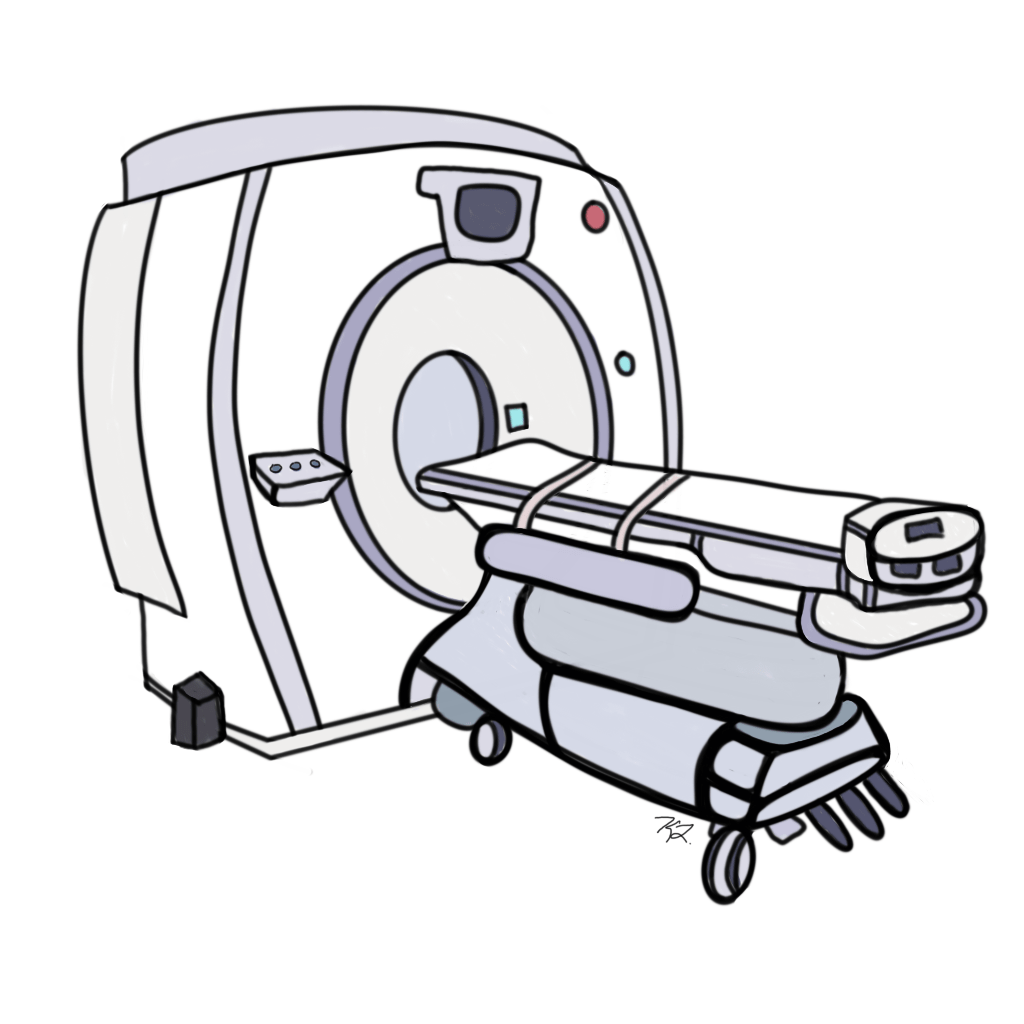
The week before the scan, we call the MRI department or they call us and we review the preparation necessary to put our four-year-old under sedation. I’m sure a lot of grownups would freak the fuck out in an MRI machine too, but for a little one, a knockout is a must if you’re going to get a clear picture. It’s loud and it looks like an alien spaceship in there. The scan takes 45 minutes to an hour or more and you have to hold perfectly still.
Sidenote: We’ve had a few 5-minute “short” MRIs where she hasn’t been sedated; two where she writhed and screamed and kicked in restraints as I held her hands, my own body hanging half out of the machine, and one where she merely whimpered and watched the Minions movie on very 1970s sci-fi looking goggles. None of them felt “short.”
On the day of the scan, we show up in the imaging department and are greeted warmly by the desk clerk. She knows us and knows our daughter’s name without looking at the card I hand her. We have a photocopy of the medical history form most people have to fill out. It’s easier and faster to just white out and change the date, and her height and weight. There’s a lot of history.
When we’re moved through to the prep room, our daughter changes into the hospital-standard flannel pyjama top (puppies or stripes) and settles in with her iPad to wait. Usually, her port (semi-permanent main line access to her blood system) has already been accessed because we’ve arrived early and done her chemo treatment before the scan. The nurse comes in and confirms her history, her allergies, and has us check the labels on all the forms. Our daughter gets her vitals done. “Leg hug please. She doesn’t like her blood pressure taken on her arm.” We catch up with the Child Life specialist, who comments on how our daughter has grown and finds out which sparkly toy she wants to look at while the sleepy medicine gets to work. We see the MRI tech, who explains the procedure for the images to be taken (which we know, but they have to review anyway) and the anesthesiologist, who explains the medical procedure and recovery process (which we also know, but they have to review anyway).
One parent empties their pockets of change and removes any jewelry and the other parent makes small talk with the nurse or the Child Life specialist. There’s the constant “eurm eurm eurm” of the MRI machine in the background through every conversation as the previous patient wraps up their imaging. They’ll be resting and recovering from sedation behind a canvas divider panel as we go in.
The empty pocket parent carries the patient into the alien-looking room where several Avengers have assembled to put our daughter to sleep and run her through the scan. The Child Life specialist swizzles sparkly sticks and our daughter pushes the button on a wand with an LED display that flashes colours and illuminates her face before her eyes roll back and she’s settled onto the bed. Empty pocket parent gives her a kiss and we meet in the antechamber of the spaceship to collect our things.
We hold hands or one of us pats the other on the shoulder as we walk through the hospital for the least romantic lunch date ever in a cafeteria filled with students and hospital staff. I get poutine. My partner gets a burrito. We plan the week and chit chat as we eat, then head upstairs to the Ronald McDonald room for free coffee (the “perks” of being a hospital regular) and some HGTV.
When we return, our daughter will be the one behind the canvas divider and we’ll wait another half hour or so for her to wake up cranky and starving. She’ll be kind of drunk for the next 24 hours. Loopy and unsteady without realizing it.
This is the routine; the easy part. It’s steps to follow, forms to fill out, a procedure to complete. Tick one box, then the next, and you’ll get through it and go home.
The hard part is the wait for the results. It’s a week or two of supressing fearful, invasive thoughts about what the scan might have to say. You’re mostly ok, but the poison bubbles up when you’re tired or when someone cuts you off in the grocery line and suddenly you’re ready to go to fisticuffs.
In the time between the scan and results, you scrutinize every wobble and stumble, every misplaced word, every mood swing and stand off (of which there are many with a four-year-old), looking for signs of what might come from the data collected. Your gut wrenches itself into knots, you don’t sleep so you drink too much coffee, you yell at both kids more than you should and you make mountains of molehills that leave you crying in the pantry. You just have this feeling that things aren’t ok.
And sometimes they are…ok. But sometimes they aren’t, and you’ve been through this so many times in the last year and a half that there is no firm ground to walk on. You know, quite legitimately, that a sinkhole sits below the playground, you just don’t know where. You also, rationally, know that worrying about it changes nothing. It doesn’t prepare you for anything. If the ground is going to fall out from under you, worrying now is not going to give you anything to hold onto. If things are going to be shitty, well, they’re going to be shitty. There’s no glory in this kind of “I told you so.” but you worry anyway, because you cannot help yourself. You have been conditioned by experience to expect the worst.
And it IS the worst, even when it isn’t, because you have to do it again. And again. And again. Every three months. It’s Ground Hog Day without Bill Murray. It’s the Day after Tomorrow without Emily Blunt and Tom Cruise. In those movies, they developed skills, there was a way out. The loop, eventually, was completed. But we don’t get Andy McDowell in the end. We’re not developing killer biceps and learning to exploit the alien’s weakness. We’re learning lots of lessons, oodles of lessons, whole heaps of personal growth, but it doesn’t break the cycle. And for our daughter, the cycle will last her entire life. It may stretch out to every six months, or every year, or maybe every few years, but the tick tock of the scanxiety clock will set the pace of her metronome unless science finds a way to silence it.
We are thankful that the technology exists to monitor her in this way, and that we have access and funding to support it. We hope desperately that the chemicals and procedures used to track and control her tumour’s growth don’t cause her additional harm in the long run. I don’t know how we learn to manage the fear and stress that it causes us and I don’t know how to teach her to manage it as she grows and becomes aware of the constant “eurm eurm eurm” in the background.
On the night before results, after a cry in the pantry, and a half dozen of my son’s Halloween treats, the best I can do is curse. Fuck this. Scans are the worst.
There are a lot of shit moments in my new world as a caregiver. My career, as it was, is on hold. There are trying times doing emotional, psychological battle with a three-and-a-half-year-old. There are long, boring waits in medical centres and rehab facilities and drawn out, anxiety-inducing waits for test results at home while we’re trying to just get on with our lives. There is always an undercurrent of fear and frustration and anger at our family’s situation and what we all have to give up and work around in the reality in which we now, and forever, find ourselves.
But, and it’s a big but (cue the immature giggles at me saying “big butt”…I spend a lot of time with kids), there is also a new pace of life and a flavour of love that we would not have if our world had not been completely shaken up this time last year.
I’m going to be self-centred and zoom into my caregiver role in particular here. If this role had not been forced on me, I would be spending this afternoon fretting over a deadline, bitching about the client that was pushing for twice what they paid for, and then frantically packing my laptop into my bag, forgetting the critical power cord in the office as I crammed myself into my car to fight highway traffic to collect the kids from daycare and school. We’d jam food in their faces before rushing them to extra-curriculars, snipping at everyone along the way, sandwiching homework and home reading in just before bed to do it all again the next day.
While that is all relatively normal, and it’s not bad, it’s also a life that feels less relevant than it used to. Because someone needs to be here, and available, managing appointments, and therapy and chemo, someone is. That someone is me and after a year, that old life feels pretty distant. I’m home and the days have to be flexible with wiggle room and room to rest, so the rat race pace is less intense. Mornings and afterschool routines are more relaxed. We schedule less and roll with it more.
My work as a caregiver, and it is work, expands to fill all the time I can give it, but there are also moments and tasks that just have to be quiet and filled with something else. I may be on call all night, but I have an hour here and there, when my daughter is with a grandparent, or watching a movie waiting for chemo, when I can just sit and read. My day-to-day life is not spent at the computer, or on conference calls, so I enjoy sitting and writing and I relish actually talking to people again.
I’m always stressed and anxious, but I also have a therapist prescribing gym time and painting to preserve my mental health. Self care is no longer a luxury, but a requirement. If my body fails, I can’t do my job, so I’ve made getting in shape a priority for the first time in my life and am sticking to it. I can’t wrap my head around an actual piece of art, but I’m picking away at painting an old doll house because I need something, anything, to do that is not involved with my daughter’s care and medical needs or family administration.
I am not going to deny that our situation, while challenging, is a hell of a lot easier in all this than it could be. Another day, I’ll dig myself into the layers of privilege we have in dealing with this whole mess that make it possible for me to not work at anything but the care of my daughter right now. (Short version: Holy shit, we are lucky we live where we do and were born into a place of comfort and education.)
I’ve spent more time with my daughter in the last year than I spent with her in her first two years of life. My relationship with my partner and my son are deeper and more grounded than I ever thought possible, because we’ve had to build different connections and ways of communicating. We spend our weekends and time together so much differently than we did before because that’s the way it has to be. We don’t try to pack too much into that time. Our situation has slowed us down, and there are definite benefits to that.
As a caregiver, as any caregiver can attest, your time is not really your own. You’re never really off duty. You never really relax. You are the day shift, the night shift and the emergency room shift. You are the repository for all the important information and the shield that the shit hits on its way to the fan. I don’t drink any more because I don’t want to be half in the bag in the ER trying to coax my daughter through a CAT scan. My partner is absolutely willing and capable of doing this, but it’s my job and I’m stubborn and I’ve got the front-line experience. I don’t want to drop the ball.
This is not a “poor me” situation (though of course I wouldn’t choose it). What I am trying to accept and fight for (with myself), now that we are out of crisis mode (hopefully for a while, ideally forever), is to still be myself in amongst all the other things. I’m trying to maintain the parts of me that I like and that I have control over.
I don’t know if my career will ever be what it was. It certainly won’t be what it could have been. My family life, another aspect of myself, will never be what a lot of other people have or what we thought it would be. I can’t control what has driven those changes.
What I can control, and am learning to relish, is the time and space between the caregiver tasks. I don’t feel so guilty about time to read, or to doodle, or to write escapist garbage, or to savour a coffee and the odd cigarette on a sunny day. I’m learning, slowly, to not ask for or apologise for that time. I’m trying to just take it. There aren’t a lot of perks to this job and unpaid interns bring home more bacon. Might as well make the most of it.


 Layer Cake Life