Category: Tips

  • Manageable

    Manageable

    … Intangible (ah y’all), bet you didn’t think
    So I command you to, panoramic view (you)
    Look, I’ll make it all manageable

    Gorillaz – Clint Eastwood

    I’m not sure I’ve ever really wrapped my head around this lyric, but it’s currently stuck on a loop in my head.

    I have a wee quirk that makes my brain play clips (e.g., song lyrics, short scenes from movies) when a particular word is mentioned or when a certain situation arises. I have to work hard not to react aloud when this little play button gets pressed in my head. It’s harmless, but it’s a thing.  

    For example, I can’t hear the phrase “Think it’ll work?” (Or some variant of it), without responding in my head “It would take a miracle.” in Billy Crystal’s voice from The Princess Bride. I’ve been supressing the urge to say it out loud since the late 80s.

    Similarly, I can’t hear “one time…” without hearing Wyclef Jean from the Fugees in Killing Me Softly. I’ve only been supressing the urge to say that aloud since the late 90s. 

    In 2023, it’s Gorillaz and Clint Eastwood. I’ve known the song for years. It’s a jam. I sincerely love it. But this year a particular word started to tweak my sound bite syndrome.

    It’s “manageable.”

    Manageable is, for the most part, perceived to be a good thing. In our world, in our medical world specifically, it generally comes with news that is not necessarily what you want to hear, but with the hope that you’re going to be able to do something about it.

    Food allergies = manageable. Pack safe food. Carry an Epi pen.

    Non-malignant brain tumour = manageable. Surgery and chemo…prognosis is good.

    Monocular vision = manageable. In time she’ll adapt and likely even be able to drive.

    “Manageable” is also how some minor deficiencies and shortfalls may be described.

    The ongoing chemo and dairy allergy combined mean that bone health needs to be watched and monitored. Your kid fractures a few things over a couple of years, and you manage that. Her bones aren’t bad, but they may need a boost in the long run. Add supplements and get exercise in where you can. Totally manageable.

    The term can also apply to complicated, scarier things that you just get used to and learn to manage over time.  

    Hemiparesis from my daughter’s stroke has been a big one to figure out, but we have teams of occupational therapists, physical therapists, and orthotists who’ve been helping us with this for years. As the person with the condition grows, they also problem-solve and figure out their own solutions. This condition was actually starting to feel like we could handle it. Plenty of setbacks, a pretty steep learning curve, and a shit tonne of work for a wee little kid, but life still happened around it. “Manageable.”

    But there comes a point when layers of “manageable” start to compound. The pandemic didn’t help for sure. New protocols and stressors. New additional challenges to learning and socializing. Again, “manageable”, but not insignificant for anyone.

    Continual tumour growth (though slow and steady thanks to the chemo) definitely added a few new layers too. At the beginning of this year our daughter was back for another round of brain surgery. They removed another massive amount of the tumour, which was awesome, but there have been consequences with her endocrine system**, which has not been awesome. Several new conditions requiring several new treatments. All of it ongoing and evolving. Some of it is life threatening in a whole new and exciting way.

    **NOTE: The endocrine system, if you don’t know, is a big deal. It kind of runs a lot of the show behind the scenes. All those hormones that regulate growth and development, hunger and thirst, urine output, stress responses, and sleep…the hormones we take for granted long before puberty even enters the picture, and we get slapped in the face with an awareness of how wild our body can be.** 

    Our daughter’s endocrine system took a hit with this surgery. Five years ago, it was a stroke, and we didn’t know if we’d get to bring the same kid home with us. This time, our daughter woke up her bubbly, chatty self, but it quickly became apparent that some of the systems running in the background were not online. 

    These new developments have been a lot to manage. 

    The trigger for this most recent surgery has itself become another few layers of things to manage. Our daughter has had vision in just one eye since she was three. Other than protecting the good eye with super stylish kid glasses (she has better taste than I do), vision was not something we really followed closely. She only had one eye, but it was a good one. Until of course, it wasn’t. Changes to her vision prompted her second major surgery. It took the pressure off her optic nerve, but she didn’t regain what was lost. 

    Now, in addition to managing food allergies, accessibility, and learning deficits from illness and absence, in addition to life saving precautions and treatments for an endocrine system that’s barely phoning it in, this 8-year-old is also managing significant vision loss. And for the most part, she just fucking does it. It’s absolutely wild how much she just rolls along and lives her day-to-day through all manner of madness. 

    But it’s another layer, on top of many other layers, that are being managed…and for all of us, our daughter the rockstar included, it’s starting to feel a lot less manageable. 

    We’re good at this. We’ve been doing this most of her life now. We have teams of supporters in and out of the hospital that dab our brows with a towel and push us back into the ring every time we take a hit. But you can only take so many hits before you can’t get back up.

    As parents, we’re also “managing” all those basic parent things, like trying to make sure both children get to school, that our daughter gets the opportunity to make friends with real live kids, that she learns to read (despite an embarrassing number of absences and a total lack of educational assistants for students with exceptionalities), that she gets to be an actual kid before she has to learn to manage all these extra shitty things herself. 

    I’m an organized, resourceful person and my partner is a smart, driven, dedicated parent. We work well together, and we have more resources and flexibility than many. But no tracking table or “ToDo” list can effectively capture all this. There aren’t enough hours in the day to manage all the 5–15-minute tasks and therapies and treatments we’re trying to implement and no app that can synchronize the choreography and timing of it all.

    Each of these things takes time and brain power and a little bit of soul. As a caregiver and a parent, some days I feel crushed by the weight of the (literal and figurative) binder we carry to hold all this information. I feel guilty that I’m not doing her exercises enough, or getting her to drink enough, or playing with her enough because I’m always trying to get something DONE. It’s the time as parent and kid that gets cut for the time as caregiver and patient.

    This is why I bristle at the word “manageable.” It’s not a bad word. It’s a good word. It carries hope and a plan of action. It also carries responsibility and weight that cannot be shifted to someone else. As much as we would like to lighten our load, focus on the positive, and affect some fucking self care, families like ours, with kids like ours, must accept that we cannot step out of the ring. The hits will keep coming and we will have to find a way to get up. (Cue Captain America sound bite: “I can do this all day.” I don’t feel it, but I hear it.)

    So, I have a few requests.

    To those who engage with us professionally and personally:

    Please remember that we’re trying. We’re trying so hard. We are never not trying, even when it seems like we’re not. There are no breaks, no vacations, and no off switch. All of that requires planning and training and protocols as well. There is only prioritization, and we can only carry so much up front.

    When we’re told that a condition, treatment, or situation is “manageable” please understand that a delicate balance is about to be disrupted and we’re trying not to explode. 

    15 minutes of therapy or tracking doesn’t sound like much but every day it has to work along with home reading, administration of meds and treatments, meal planning and prep, extra admin work and communication, insurance forms, emails advocating for or requesting services, extra calls with school staff, searching for shoes that fit over bulky orthotics, searching for or driving to activities that may or may not cater to your child’s particular needs, pharmacy runs, spontaneous specialist appointments and calls, midnight ER visits, and somewhere in there…we have two children that need us to pay attention to who they are actually becoming and what they need amongst the noise to be real live people.

    Oh, and we also have to find a way to be employed. Maybe maintain a relationship or two. Maybe work on being human ourselves, instead of just the sum of our functions.

    “Management” is the right word to use. Caregiving a job. It requires focus and expertise and an understanding of overarching goals and how it all fits together. It takes time to build the skills and the systems to integrate new tasks and procedures and we, as parents of medically complicated kids, don’t generally get a lot of time to do that. You are not likely the only one throwing a wrench in the system this week. We appreciate that it’s all important, but It’s. All. Important. 

    So please…

    1. Be patient.
    2. Be flexible. Your time is at a premium, but so is ours.
    3. Tell us the good news (when you can).
    4. Acknowledge the things we’re already doing and highlight what we’re doing right. This can change the course of our day completely.
    5. Remember that our (brain) storage space is limited, and our processing power is taxed. Speak plainly and write terms, next steps, and drug names down. Give us something to Google and a reliable source to consult when we have time to process what you’re asking us to do for/with/to our kid.
    6. Support caregiver leave, pay, home care, and respite. There are so many ways to do this.

    Every day, parents of medically complicated kids are doing things we didn’t sign up for and for which we have received no training. It’s a job on top of a job on top of a job.

    To those who already do this…Thank you!

    To those who do not…

    Take a panoramic view. See who we are as a family in the context of our child’s condition. For good or for ill, it frames everything for us.

    Make it tangible, digestible.

    And you’re going to use the word, please use your skill set and expertise to help make it genuinely manageable. 

    Ok…I get the sound bite connection now. Thanks brain.

    Enjoy some Gorillaz.
  • Hospital Life 101: When Your Loved One is a Frequent Flyer

    Hospital Life 101: When Your Loved One is a Frequent Flyer

    Lifetimes ago, when I first started this blog, I wanted to be helpful. Back then, I was overwhelmed with the idea that my kid would go through life with a collection of food allergies that exceeded the capacity of her medic alert bracelet. I figured others must be out there, feeling the same way.  

    I was new to a world with specialists and protocols, and I was neck-deep in a lake of frustration and logistics that most other families and a lot of other kids didn’t have to deal with.   

    I wanted to connect with other parents who were trying to figure stuff out.  I wanted to make them laugh and roll their eyes and stomp their feet in empathetic fury when an ignorant dink (who could have been me in another parenting life) sent their four-year-old onto the playground climber, covered in a thick schmear of peanut butter. Observation: The same kids always seem to have cheese-powdered Doritos in hand. (Just clean their fucking hands first, is that so hard!?!)

    Clearly, if you’ve read anything on this blog before, you know that was just the tip of the iceberg with the list of conditions and obstacles my daughter has had to overcome. The food allergies, at this point, feel like a foot note.

    It’s a pretty common scenario to be half an hour into her medical and therapeutic run down, when I add “Oh…I forgot to mention…she’s ALSO allergic to everything in that other kid’s lunch box, so don’t let her touch it.”

    We have become members of many “exclusive” clubs and my daughter seems to dance between a number of them at any given time. Some of her conditions are uncommon, but the deck of membership cards seems to grow rather than shrink as the years go by. One club tends to lead to another.

    Not everyone carries the pediatric brain tumour card. Even fewer carry the pediatric stroke card. The combo of those two is another slice (of a slice) of the statistical pie and together they lead her, by pure shitty luck, into different undesirable categories of rare and scary scenarios for growth and development.

    Some of her conditions, resulting from her major medical stuff, exclude her from things that are typical for kids her age (like riding a standard two-wheel bike). Society excludes her from a few more (like front-door access to her school or playing tag with peers at the park). Food allergies were just the first level of all that. Her conditions are varied, overlapping, and like every kid…unique.

    As a result of all this, we are “frequent flyers” at the local children’s hospital.  It’s a good one. It has all the departments.

     And over the last three years, we’ve been trying to hit as many as we can. I’m pushing for a set of collector cards!

    We’ve run into so many magical people in so many different roles, all nestled within the different levels and departments of the local medical community. I can totally picture what their ability stats and “hit power” would be. We’ve all got our weaknesses and weapons and armour. There are so many characters in our medical world that would absolutely blow up in manga-illustrated glory.  

    At our level, we’d have cards for something along the lines of 20 different specialists and/or departments; everything from cardiology to ophthalmology, endocrinology to intensive care, gastroenterology to (of course) oncology. 

    We’d have all three neurosurgeons from our hospital’s collection. A complete set!

    There are definitely families that would leave our collection in the dust. They have enough cards in their decks to earn VIP status — with lounge access, fresh fruit, and foot massages.

    We’re probably closer to free coffee and an extra blanket with every overnight stay. We’re there a lot, but others are there much more. 

    Players who’ve been collecting a long time, with all their cards in hand, can tell you which bathrooms are still clean at 5pm and which bathrooms will be out of toilet paper by 10am. They can tell you which hallways are empty after rounds (if you need a place to sit on the floor and cry) and tell you which cafeteria worker will smile and call you “honey” when you need a nonclinical face to be kind and hand you hot french fries with cheese and gravy. 

    They offer sympathy and laughs and hand you the remote for the waiting room TV (if you’re allowed to change the channel). They understand that look on your face, when the doctor has left the room, and give you a nod. 

    Knock on wood, our collection has recently been focused on the outpatient edition. We’re still collecting new cards from around the hospital, but we’re mostly there for touch points, and check ups, and bloodwork.  We’re in maintenance mode right now, but you never know when a new and exciting card is going to make its way into your deck. 

    For players who are new to this game, whose decks are small but growing, I’m sorry.  It’s not a fun hobby, but there are skills you can acquire and steps you take to make the most of the cards you’ve got in your hand.   

    Tip 1: Assume everyone is having a shit day.

    Be nice. Not sugary sweet, but respectful, compassionate. Give someone an energy boost if you can.

    This applies to pretty much everyone you encounter that works in a hospital. People are at their worst in a hospital and staff often take the hit for that. Some people who work there will be turds because health care workers are human beings. But I’ve lost track of the number of occasions where a custodian, porter, volunteer, nurse, or friendly doctor in the elevator have completely changed the tone of our experience for the better with a small and simple gesture. Hold a door, smile, be patient, be polite, let someone know when they’ve helped you, show appreciation, and take a breath before you take someone’s head off.

    For the love of God, treat the parking staff like human beings. People are rude to them all day and their office is likely in a windowless sub-basement. Like most human beings, they deserve a little empathy. Even if they seem grumpy at first, they’ll remember you were kind and they’ll be kind too. You will lose your parking passes. The gate will get stuck. You will leave your lights on and need some help when your battery dies…on top of everything else you’re dealing with that day. 

    Pay the good stuff forward and try to internalize an assumption that everyone in that building is going through something you don’t know about and could use a pick-me-up. 

    Tip 2: Back your car into hospital parking spots. 

    This sounds like a small thing, but it is important. Underground parking spots are teeny and the rows are tight. Everyone there is parking under some kind of duress. If you drive forwards into a spot, someone will absolutely park too close for you to effectively extract your vehicle when it’s time to leave.  You’ll end up doing an 87-point turn when you’re emotional and overtired and the parking attendant will have to come over to redirect traffic the wrong way so you can wiggle your way out like a chump. Back in. Trust me.

    Tip 3: Keep a “hospital bag”

    If you’ve got a kid, you’ve probably had that backpack or suitcase in your closet in the weeks before your due date. If you’ve got a person in your life who is medically vulnerable in some way, pack that bag and keep it handy. At 2am, when shit goes down, you’ll be glad you did. 

    Things to keep in the bag:

    • A change of clothes (PJs work for almost all occasions) and underwear for the patient
    • Slippers or flip flops for the patient
    • A spare stuffy or comfort item (as age appropriate…a bottle of gin to calm mom’s nerves will generally be frowned upon)
    • A notebook and pens, crayons, markers (good for entertainment or blurry-eyed note taking of terms or follow up steps), tiny toys, or cards
    • A printout of medical conditions, medications, surgeries, medical history (there are a lot of forms to fill out and questions to answer in an ER situation and sometimes it’s hard to recall dates and doses on the spot)
    • A towel. Douglas Adams was right. A towel is always useful. (It’s a blanket, a pillow, a wrap for belongings, a barf catcher, or you know…a towel.)
    • A spare charger for your phone
    • A set of ear buds or headphones
    • Snacks (granola bars, raisins, instant oatmeal packets to make breakfast in a Styrofoam cup with nothing but hot water)
    • Wet wipes and deodorant. A comb. A toothbrush. Hair elastics if you or the patient use them.
    • Tylenol/Advil. Fatigue often comes with a headache. You will be tired and your head will hurt or your back will seize up from those terrible chairs. The pain meds the hospital provides are not for you. They’re for the patient, so bring your own. 

    Something to keep on the bag:

    • Tape a piece of paper to the bag with a list of things you’ll need to add to the bag before running out the door
      • Health card
      • Current meds
      • Cell phone or device to entertain the patient
        • Note: If you have a tablet of some kind, it’s good to keep a download of shows or movies the patient likes on there all the time. This is a good job for siblings to help with. They’ll pick better stuff than you. Maybe apps or games they like. Drawing apps are always fun. Makes long waits around the hospital a little less cranky and you won’t have to worry about patchy (or expensive) Wifi access.

    Tip 4: Keep a set of hospital clothes to throw on at a moment’s notice.

    The first time you do a 2am ER run, you’ll go in your pajamas. The next time, you’ll be ready to settle in for a longer stay. Keep a little bundle of the following on a shelf somewhere in your closet.

    • Sweatpants (You’re not trying to impress anyone here. You can sleep in these and you can wear them around.)
    • T-shirt and hoody (Hoods are good to pull over your head to grab a nap under fluorescent lights. You’ll want layers because hospitals are either freezing or raging hot. There is no connection to the weather outside.)
    • Socks and slip-on shoes.
    • A comfy low impact sports bra (or equivalent). I cannot stress this enough. Find a bra that is comfortable enough to sleep in (no underwires!), but hides your nipples (if you have an issue with your nipples being seen). Residents will barge into a room at 8am, fully dressed and full of coffee and expect you to bounce up off your reclining chair/pull out bed beside the patient to answer questions or get an update. If you wear a bra, make sure you have one you can sleep in. 

    Tip 5: Keep a “book”.

    Every game has a guide. When we first got into this whole business, we had daily notes to keep. There was a tsunami of information to be processed on very little sleep. You’d be surprised what the average caregiver has to track and recall. There are a lot of questions about what goes into and out of your kid. Not just meds and tests. At some point, you’ll find yourself trying to figure out how to convert three sips of apple juice into milliliters. At some point you’ll have seven different descriptors for poop you’ll have to choose from. There will also be a lot of jargon and terminology you don’t understand.

    Make notes. Don’t be afraid to ask the specialist or nurse to repeat themselves or to write the name of that drug they’re adding to the IV. Stick test results and discharge papers in the book. Get one with pockets or add a clip to attach prescriptions or requisition forms you need to hold onto. You’ll get the paper requisition for the blood series in hand and an appointment for that specialist several months later. They’ll expect you to have the paper requisition…even though it’s all in the same building…on the same computer system. I have no idea how hospitals work.  Just hold onto the papers.  

    We’ve gone through several iterations of “the book” and over the years I’ve printed different templates and customized calendars to our tracking needs. Most of it I’ve abandoned for a simple duotang with some print outs and some loose-leaf lined paper. Find a system that works for you and one that any other caregivers or partners can understand and follow.

    • Keep notes after appointments. Note the date, which specialist you saw, and the general gist of what they said.
    • It’s a good idea to have a section for “ToDos” where you can list the calls you need to make, insurance claims you need to file, and specialists with whom you need to follow up. There are apps for all this stuff, and I find reminders are good, but it’s easier to hand a notebook to another caregiver, and there are so many pieces of paper you’ll have to file somewhere anyway. Might as well go analog. Also…it’s highly likely your kid will be watching something on your phone, or your battery will die, just when you need it. 
    • You can dedicate a page to each specialist if you’re particularly organized. When something comes up that needs to be passed down to the next specialist in the chain, you can note it on their page and check that specialist’s page when you have that appointment. It’s easy to forget what you wanted to ask when you’re on the spot. 
    • Note questions you have on the way home (because you always forget to ask something).
    • Keep a master calendar of key “events” that have happened over the last 6 months or so. This can be consulted “at-a-glance” when you need to answer questions about dates for things like changes in dosage, weight and height notations, scans and results, medication cycles, ER visits, or past specialist appointment dates.  

    If that all feels like a lot…it is. Shuffling the deck and keeping track of the cards you collect is overwhelming. Most of the time, it’ll feel like you haven’t got a clue what you’re doing and often it’ll feel like you’re doing everything wrong. You know…it’ll feel like parenthood.

    We didn’t know that we were signing up for all these clubs. We didn’t read the fine print and we don’t have a binder big enough to hold all the cards we’ve collected over the last three years, let alone the cards we’ll collect over the next, like 20, as our daughter grows and her condition changes. 

    But the experience points we’re gaining are off the charts. We can handle a hit without taking too much damage. Our kids have both earned battle scars that hurt but we know those experiences will make them stronger and more empathetic in the future. 

    Whatever deck you’re collecting, I hope it’s a limited edition. I hope you get some shiney special edition cards that power you up and I hope you make smart trades and assemble the best line up you can to get through it all.   

  • Excursion Essentials

    Excursion Essentials

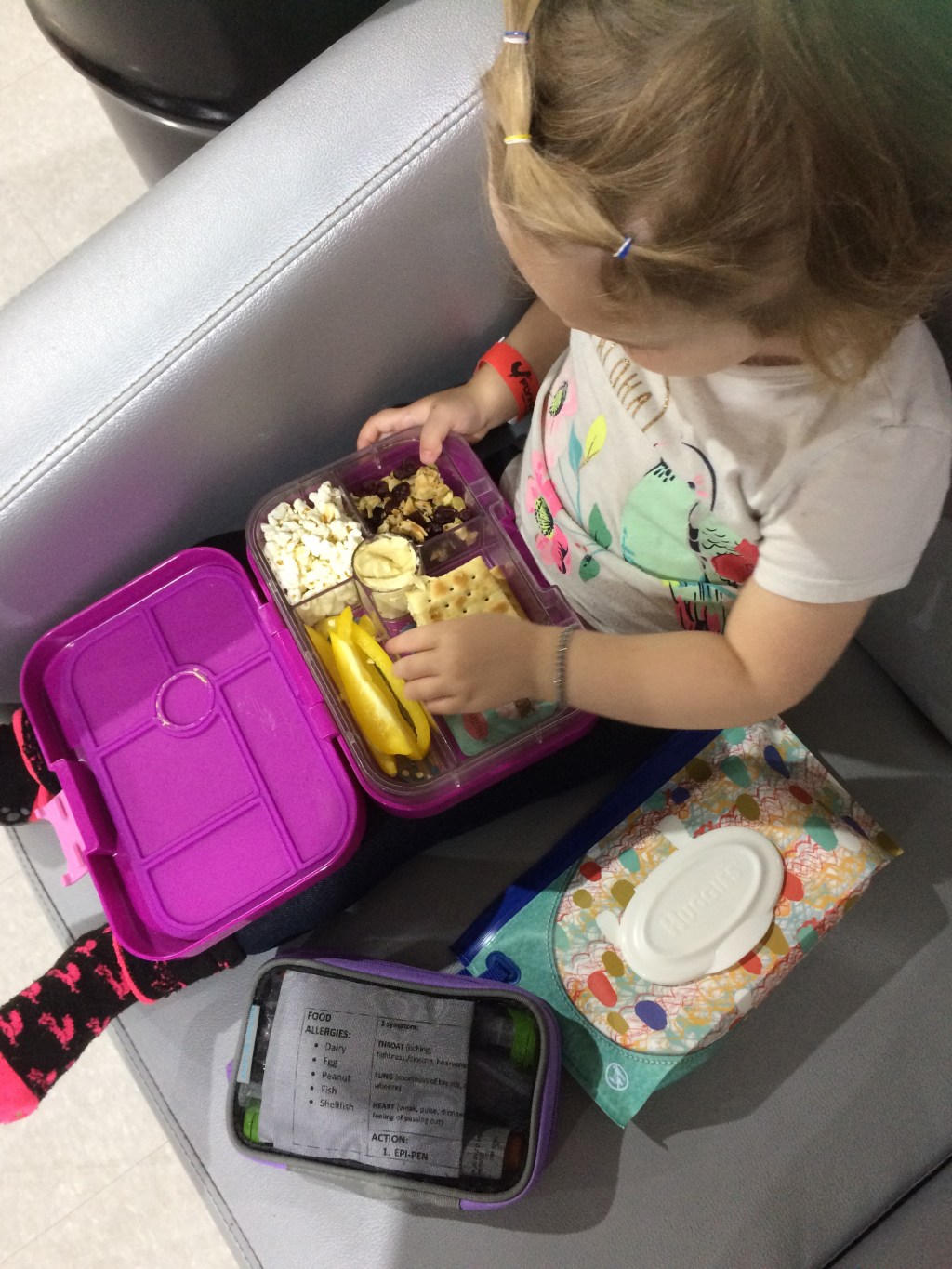
    As I’ve mentioned in a previous post, when we go out, we go with food.  Thought I’d post a quick essentials list for what we look for and what we always have on hand when it’s time to eat.

    To date, we’ve never had a problem with bringing in our own food.  I know others who have, but in general, employees back away slowly and smile when we list off our daughter’s allergies.  Mostly nobody cares or notices. I think as along as nobody is screaming or making a huge mess, most establishments are pretty cool with a kid quietly snacking in a corner. We even clean up before AND after she eats…what’s not to like about a customer who does that?

    The “Look Fors”:

    1. Quiet corner away from main food service

    2. Vinyl chair…easy wipedown.

    What we always bring:

    3. Wipes (before, after, during…We buy BIIIIIGGG boxes of wipes.)

    4. Yumbox. This thing has been a game changer when we go out. Totally shameless plug here. It’s stupid expensive for a lunch box, but you need the right tools for the job, and this thing really works for us. The compartments are sealed when closed, it’s well-weighted so doesn’t tip, and our toddler can open and close it. Where we go, it goes.

    5. Emergency kit: 2x auto injectors, anaphylaxis plan cheat sheet (short version to hand to servers etc. when out), antihistamine.

    That’s it. Easy peasy. Just do that everywhere and you’re good.